



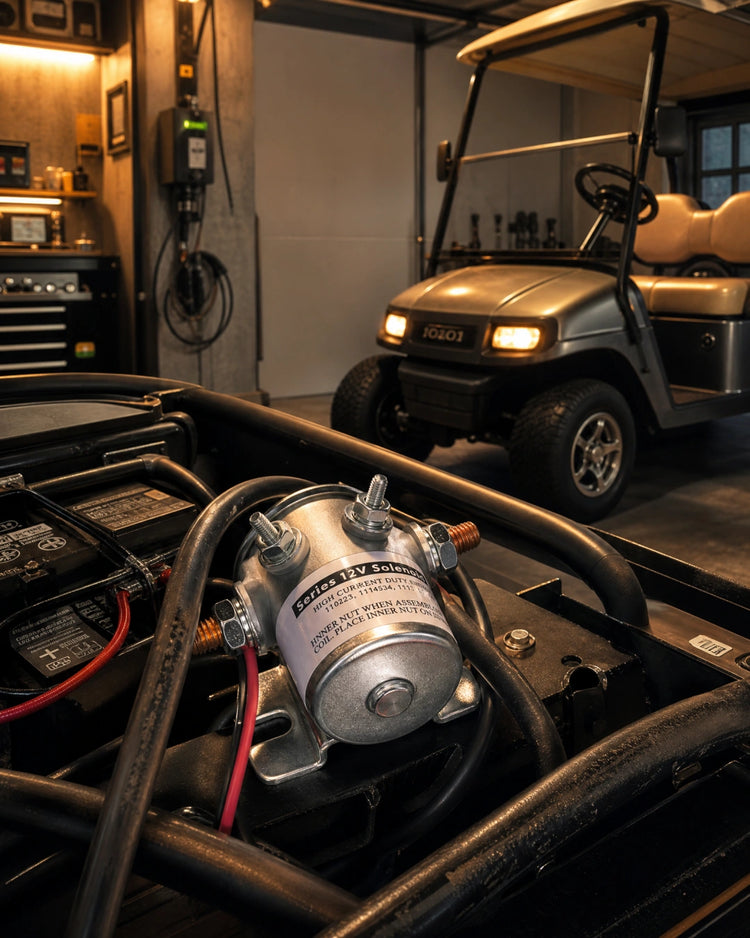



A failing solenoid can manifest in several ways. Key signs include: no movement at all when you press the accelerator, repetitive clicking sounds or a completely silent solenoid without a click, intermittent operation where the cart sometimes works and sometimes doesn't, erratic acceleration (like lurching or jerking), and the cart unexpectedly stalling or dying while driving. In severe cases, the starter might even continue to run after the cart has been powered down, which indicates the solenoid contacts have welded or stuck together.
A clicking sound when you press the pedal indicates that the solenoid's low-voltage electromagnetic coil is working and is receiving the signal to activate. However, the click alone doesn‘t mean the high-current circuit is closed. The most common reason is burnt, corroded, or carbonized internal contacts that prevent the flow of electricity from the battery to the motor, even though you can hear the mechanical engagement. It’s also possible that the click confirms the solenoid works, but the issue lies elsewhere, like the controller or motor brushes. You can sometimes temporarily confirm a stuck contact by gently tapping the solenoid with a rubber mallet; if the cart moves, the solenoid is failing mechanically.
You can test a solenoid with a multimeter in a few steps:
-
Voltage drop test under load: With the multimeter set to DC volts, place the probes on the solenoid's two large terminals. You should read the full battery pack voltage before pressing the pedal. Press the accelerator and note the reading. On a healthy solenoid, the voltage will drop to near 0V (typically less than 1-2V). If the voltage drop is significant (e.g., >5V), the contacts have high resistance and the solenoid is bad.
-
Coil resistance (Ohms) test: Disconnect the cart's power and set your multimeter to Ohms (Ω). Place the probes on the two small terminals. A healthy solenoid coil should show a resistance reading, typically between 20-100Ω. A reading of infinite resistance (OL) indicates the coil is burnt out and the solenoid must be replaced.
-
Continuity test: With power disconnected, set the multimeter to continuity. Touch the two small posts to test the coil. Then, test the two large posts with the solenoid de-energized (pedal not pressed). You should NOT have continuity between the large posts. If you do, the solenoid is stuck closed.
Yes, a bad solenoid can contribute to battery drain. A solenoid with welded or stuck contacts can leave the circuit partially closed, creating a parasitic electrical load even when the cart is turned off. Over time, this constant draw will slowly deplete your batteries, which is a primary cause of dead batteries after a few days of sitting unused. Even a correctly functioning but poor-quality solenoid may draw a tiny bit of power, but a stuck one is a major culprit.
The voltage rating of the new solenoid must match your cart's battery pack and system voltage. A 36-volt golf cart requires a 36-volt solenoid, and a 48-volt cart requires a 48-volt solenoid.
-
Installing a lower-voltage solenoid (e.g., 36V) into a higher-voltage cart (e.g., 48V) will cause the solenoid‘s internal coil to quickly overheat and burn out.
-
Conversely, a 48V solenoid in a 36V cart may not engage reliably because the coil isn’t receiving enough voltage to create a strong magnetic field.
Intermittent power loss is a classic symptom of a failing solenoid. Internal components can wear unevenly, or contacts can become pitted and corroded, causing high resistance that comes and goes. Other common causes include loose or corroded wiring and battery terminals, which create inconsistent connections, and a failing MCOR (Motor Controller Output Regulator) in Club Car models, which is the throttle sensor that tells the controller how much power to deliver.
A solenoid's lifespan is measured in cycles rather than years. A typical OEM-quality solenoid can last for around 10,000 to 50,000 operations, which, for a daily-use cart on a busy golf course, translates to roughly 4 to 6 years. Under light, occasional use, they can last much longer, sometimes even the life of the cart. Factors like extended hill climbing, heavy loads, or constant stop-and-go driving generate more heat and will shorten its life.
Yes, for most golf cart models, replacing a solenoid is a straightforward DIY project that requires basic hand tools like a socket set, wrenches, and pliers. The essential safety steps are to always disconnect the main battery pack negative cable before starting any work to prevent electrical shorts and wear insulated gloves for high-voltage safety. The key is to take a photo of the existing wiring on your old solenoid before removing anything to ensure you wire the new one exactly the same way. While often straightforward, some models (like EZGO RXV) require a specific solenoid matched to the controller, so always double-check your specific cart model’s requirements before purchasing a replacement part.